






Climb aboard a hayride in Washington County this fall, and you’ll ride in something with more history than you might guess. Yet the wagon is really just where this story starts. After all, long before horse-drawn wagons carried visitors for fun, they carried the harvest itself – and the neighbors who helped bring it in.
From there, the story spreads out: barns built for threshing, canal boats loaded with the season’s last potatoes, corn shucking parties that lasted long after dark, and neighbors gleaning a field so nothing went to waste.
As you’ll see, Washington County’s fall traditions run deeper than cider doughnuts and colorful leaves, and the hayride is just the first stop.
A County That Harvested By Hand
Mechanical mowers reached most of New York by the 1850s. But they arrived here later than almost anywhere else. According to Adirondack historian Glenn Pearsall, farming families here were still cutting hay and grain by hand. That was true across Warren, Essex, and Washington counties alike. Long-handled scythes did the work well after the Civil War. That meant harvest season required people, not just equipment, and lots of them.
Neighbors pitched in accordingly. Women in the region regularly gathered to help process the season’s crops together. Sometimes, young unmarried women passed the time with a bit of harvest-season fortune telling. They would peel an apple in one long strip, then toss the peel over a shoulder. Whatever letter the peel formed supposedly spelled out a future husband’s initial!
Later, once the work wrapped up around dusk, farmers headed home for supper. Evenings often closed with a fiddle or hammer dulcimer. Music was one of the few entertainments a farm family had close at hand, perfect for lightening the spirits after a long day of work.
Corn Shucking and the Frolic
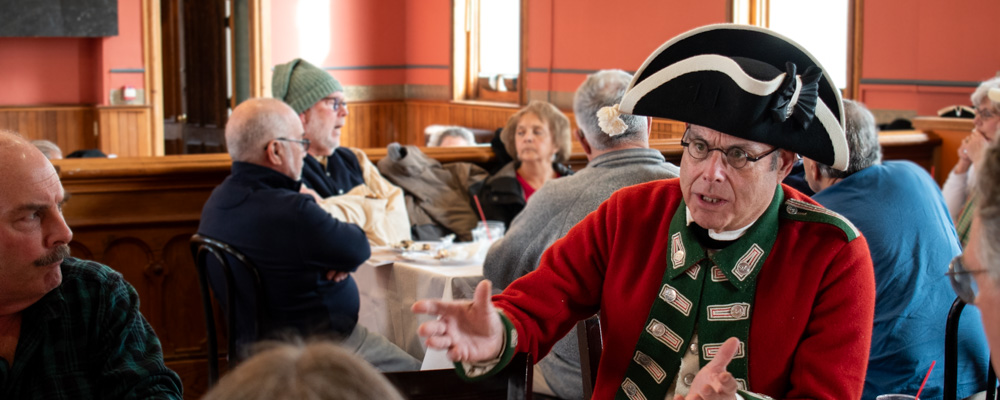
One of those neighborhood gatherings stood out from the rest. Corn shucking, also known as a husking bee, was the harvest tradition built entirely around inviting the neighborhood over. First, a family would let their corn dry for a few days after picking. Then they would send word around the area that a shucking would happen on a certain day. Guests would arrive to strip husks from the ears, often turning the work into a race between two teams. By the end of a single busy afternoon, the crop was ready for winter storage.
Of course, the work was only half the event! Once the shucking wrapped up, the “frolic” began, and it rarely stayed quiet for long. A big meal came first, often built around whatever the harvest had just brought in. Storytelling followed, ranging from tales of years past to the occasional ghost story meant to send a chill through the room. Dancing, singing, and games like corn throwing and plate rolling kept the night going. It’s easy to see why these gatherings had a reputation for running late and getting rowdy.
A Barn Built for Threshing

Yet corn wasn’t the only crop that demanded a crowd. Grain needed a building of its own, and you can still see one raised for exactly that kind of labor. It just holds something else entirely today.
The main exhibit hall at the Slate Valley Museum in Granville began as a New World Dutch Barn around 1840. Workers later moved it from Ravena and rebuilt it on-site. The original builders designed its distinctive H-shaped frame for one purpose: threshing and storing grain and hay. Today, that same frame holds exhibits on slate quarrying instead of harvest equipment. But the barn’s bones still tell the older story. A structure raised for one historic industry now preserves the memory of another.
Celebrate The Canal’s Role in The Harvest

Once a crop was threshed and ready, it still had to reach a buyer. For much of the 1800s, the Champlain Canal was how that happened. Boats running between Whitehall and the Hudson carried grain, apples, potatoes, butter, and cheese. Cargo moved out of Washington County toward markets in New York City and Montreal. A newspaper account from November 1895 names names: it records Albert Stewart of Argyle and T.J. Potter of Fort Edward loading their final boat of the season. The boat held potatoes, loaded just days before the canal closed for winter.
Today, Fort Edward still marks that connection between the canal and the harvest. The town hosts an annual Locktoberfest happening during that same autumn stretch, when farmers once sent their potatoes and apples downriver. That makes the modern celebration less of a new invention and more of a season reasserting itself!
Read more about the canal’s full history in our guide to the canals of Washington County.
Hayride Traditions: From Field to Frolic

This brings the story back to the hayride itself. Before it was ever recreational, a hay wagon was simply how the harvest got from field to barn. So too for the people gathering it. Farmers loaded the wagon high with hay or grain, then a team of horses pulled along the same dirt lanes farmers had used for generations. Back then, the wagon was pure function.
Eventually, that function became fun. Now, a similar style of wagon carries visitors through Fairgrounds during special events such as the Washington County Fair and the Adirondack Wool & Arts Festival.
Local farmers help keep the tradition alive, whether it’s an actual hayride, a horse-drawn wagon ride or a tractor-drawn one. You can experience this quintessential activity during apple-picking season at McWhorter’s Orchard in Argyle, the Winterfest celebration at Lake Lauderdale, or during spring’s maple season at Dry Brook Sugar House!
Not every hay wagon in the county has made that switch, though. Drive the back roads of Whitehall, Granville, or Hartford, and you can still see hay gathered the old-fashioned way. Washington County is home to a growing Amish community. Their farms still rely on horse-drawn equipment to cut, rake, and gather hay. It’s the same work this whole industry started with, still happening in real time.
A Tradition Older Than the Farm
Every harvest tradition covered so far arrived with European settlers. But that’s not where the true story of local harvest traditions began.
People had already worked this land for thousands of years before any of it was written down. The Rogers Island Visitors Center in Fort Edward highlights the region’s earliest known inhabitants, noting that Native Americans hunted and fished along this stretch of the Hudson for at least 6,000 years before Europeans arrived. They called the area Wahcoloosencoochaleva, “The Great Carrying Place.” The Mohican people are believed to have inhabited this same stretch of the Hudson Valley before colonial settlement reached it.
Corn shucking itself traces back to this deeper history. According to North Carolina’s state historic sites program, communal cornhusking gatherings were a vibrant Native tradition. The practice was well underway long before European settlers arrived here. European settlers later adopted the practice and adapted it into the version described above.
In other words, these community-centered harvests have roots that reach back further than the county itself.
Nothing Went to Waste
Communal labor wasn’t the only harvest-season tradition built around neighbors helping neighbors. Gleaning was another. This was the practice of the community gathering whatever was left in a field after the main harvest. That way, a crop’s leftovers still fed people instead of going to waste.
That same idea is alive and working today. Comfort Food Community, based in Greenwich, runs a Food Recovery Project that gleans excess produce directly from local farms. It also rescues food from area markets that would otherwise be thrown out. It’s a prime example of an organization using the same principle, solving the same problem, more than a century later.
Crafting Through the Cold Months

Another type of gathering got neighbors working side-by-side: quilting bees. These followed a similar shape indoors, especially once the harvest was in and the weather turned.
Fall brought its own fiber work too, entirely separate from wool or cotton. Farm families who grew flax pulled the stalks by hand in late summer. They retted flax by spreading it across dewy fields for several weeks, a process that broke down the tough outer stalk and freed the fibers inside. Only after retting could the flax be broken, scutched, and combed into something a spinning wheel could use. That work often carried into the colder months, alongside quilting, wool spinning, and other indoor crafts.
These fiber and craft traditions are still very much alive today in Washington County, just on a different calendar. Each April, the Washington County Fiber Tour opens up local farms to visitors. You can meet sheep, alpacas, cashmere goats, and angora rabbits, all raised for their fiber. Quilted and woven work gets its own moment each August too, judged alongside other handmade pieces in the Fair’s Home Arts department. Every September, the Hudson-Mohawk Weavers’ Guild shows off spinning and weaving skills at the Adirondack Wool and Arts Festiva in Greenwich.
From wool producers to weavers, the county’s own Fiber Trail carries that spirit forward. It makes a full trip of its own for anyone drawn to this kind of hands-on heritage.
Unique Ways to Join and Enjoy the Harvest

That hands-on spirit runs straight through the harvest, too. Most of these traditions were built around participation, not spectating, and that part hasn’t disappeared.
Grapes make the case best. At South Dominion Vineyard in Cambridge, the land has been farmed continuously for nearly 260 years. Guided history walks there connect that whole span directly to the grapes growing on the property today, so the harvest you’re watching happen is similar to what the land has always produced, in one form or another, since long before the vines went in. A little further north in Valley Falls, Ives Hollow Vineyard lets you pick your own cold-hardy grapes across a handful of weekends each fall.
The rest of the county follows the same spirit. You can dig your own potatoes at Goose Island Potatoes in Argyle, or fill a bag with apples at Hicks Orchard in Granville. Plus, pumpkins, gourds, and winter squash show up at farm stands across the county this time of year. You’ll find them at Tiashoke: Farm, Store & More in Easton and Gardenworks Farm in Salem, among others.
Each October, the Hartford Harvest Hop opens up a handful of working farms for a free, self-guided tour . Stops span Hartford, Fort Ann, Salem, and Granville. It invites visitors to meet the animals, chat with the farmers, and sample what each property produces, from pasture-raised meats to maple syrup and honey.
The Washington County Fair itself offers another variation of renewed harvest traditions. Its Open Class competition includes dedicated divisions for Farm Crops, Fruits, and Vegetables, alongside separate categories for flowers, eggs, syrup, and honey. Anyone in the county can enter their own homegrown produce for judging, right alongside neighbors’ best tomatoes, pumpkins, and potatoes. It’s a direct descendant of the same agricultural society competitions the Fair started with generations ago.
Check our guide to pick your own farms in Washington County, or for more fun fall activities, see our fall farms guide.
More Fun Things To Do Nearby
Ready to keep exploring? The Farm Museum earns another look in our post on its equipment collection and its own 1853 one-room schoolhouse. The County Bounty Tour each September puts you directly on the farms behind the county’s food and drink scene. And if hayrides and pumpkins have you wanting more, our guide to fun fall activities rounds out the season.

